


The Cold Atom Theory Group focuses on fundamental theoretical problems in ultracold atoms and quantum simulation, as well as theory closely connected to ongoing experiments. Our work is focused on three main topics:
1. Development of advanced algorithms
We advance the frontiers of theoretical studies of quantum many-body systems by developing and applying advanced computational methods. The techniques we specialize in include: Quantum Monte Carlo (QMC), especially Path Integral Monte Carlo (PIMC) and the Worm Algorithm; mean-field theory; the Density Matrix Renormalization Group (DMRG); Exact Diagonalization (ED); Bethe Ansatz; and AI-driven quantum many-body algorithms.
2. Theoretical studies of ultracold atomic gases
Using these tools, we investigate key theoretical questions in ultracold atoms and quantum simulation. At present, our research is mainly focused on low-dimensional and cross-dimensional quantum gases. Topics of interest include: quantum phase transitions and emergent exotic phenomena in cross-dimensional cold atom gases; quantum correlations in cross-dimensional systems; localization transitions and the Bose glass phase of cold atoms in quasicrystals; and non-equilibrium dynamics in low-dimensional gases.
3. Close collaboration with cold-atom experiments
We maintain active partnerships with experimental teams from three main sources: experimental teams within the CAP group at Peking University, experimental groups in China, and international experimental teams. These collaborations are highly synergistic: on one side, we provide theoretical input on feasible experimental parameter regimes and offer physical interpretations of experimental data; on the other side, our collaborators perform experimental tests of our theoretical predictions.
In recent years, working closely with these collaborators, our group has co-authored one paper in Science, two in Nature Physics, two in Science Advances, and one in Physical Review Letters (featured in Physics). Further details are provided below.
1. Dimensional Crossover Research with Prof. Hanns-Christoph Nägerl's Group
Our collaboration with the groups of Prof. Hanns-Christoph Nägerl (University of Innsbruck) and Prof. Thierry Giamarchi (University of Geneva) has yielded significant insights into dimensional crossovers. Using a strongly interacting Bose gas in an optical lattice, we tracked the evolution of quantum correlations from 2D to 1D [Nature Physics, 20, 934–938 (2024)]. We found that the system exhibits a fascinating dichotomy: it behaves one-dimensionally at short distances but two-dimensionally at long distances. We provided a physical interpretation for this based on the behavior of creation and annihilation operators.
In a related work, we developed a low-dimensional thermometer with 1-nanokelvin precision by combining Quantum Monte Carlo theory with experimental time-of-flight data [Science Advances 10 (7), eadk6870 (2024)]. This capability allowed us to uncover an anomalous cooling effect that occurs during the dimensional reduction, which we explained by analyzing the system's entropy. Building on this, our collaboration with Prof. Nägerl and Prof. Lei Ying (Zhejiang University) investigated many-body dynamical localization in this 1D system, realizing the quantum kicked rotor model with strongly interacting bosons [Science 389, 716-719 (2025)].
Related Links:
https://www.nature.com/articles/s41567-024-02459-3
https://www.science.org/doi/10.1126/sciadv.adk6870
https://www.science.org/doi/10.1126/science.adn8625
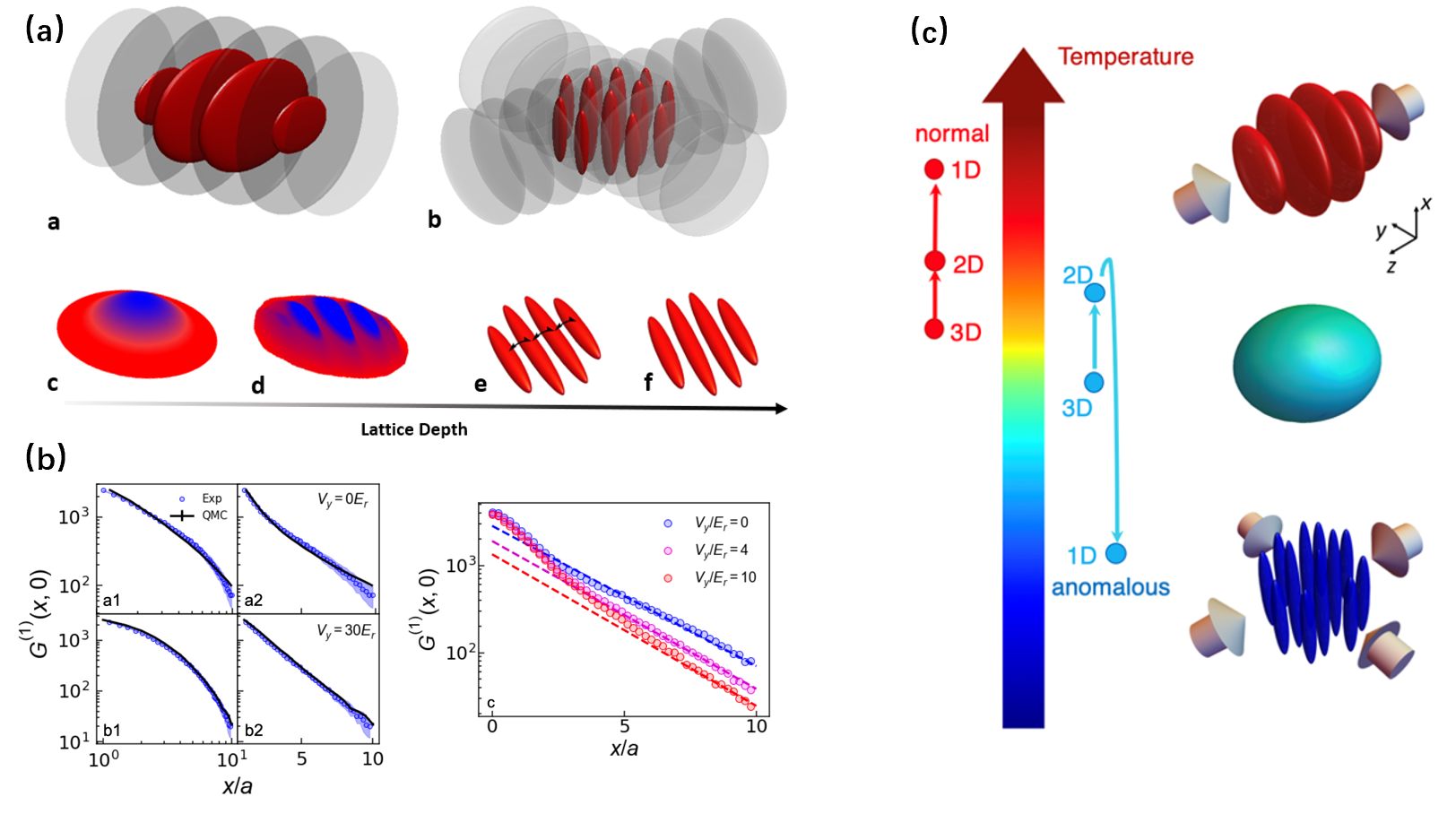
Figure 1. (a) A schematic illustrating the creation of 2D layers and 1D tubes from a 3D Bose-Einstein condensate (BEC). (b) The low-dimensional cold atom thermometer, constructed using Quantum Monte Carlo simulations and time-of-flight imaging. (c) The observed anomalous cooling phenomenon during dimensional reduction.
2. Observation of Tan's Contact in Collaboration with Prof. Xuzong Chen (Peking University)
In a collaboration with the groups of Prof. Xuzong Chen (School of Electronics, Peking University) and Prof. Laurent Sanchez-Palencia (École Polytechnique), we utilized a one-dimensional, strongly interacting ultracold Bose gas to report the first direct observation of the universal 1/k⁴ tail in the momentum distribution [Science Advances 11, eadv3727 (2025)]. The weight of this high-momentum tail allowed for a direct measurement of Tan's contact.
This achievement was enabled by a two-step expansion and probing scheme that we proposed, which significantly suppresses the influence of interactions on the high-momentum region during time-of-flight measurements. Furthermore, we extended the study of Tan's contact for bosonic systems into the strongly correlated regime. By systematically tuning the optical lattice depth, atomic number density, and the 1D scattering length, we provided the first experimental verification of the universal scaling law for Tan's contact, as predicted by the Lieb-Liniger model. This work lays a crucial foundation for measuring both macroscopic and microscopic properties associated with Tan's contact in strongly correlated bosonic quantum systems.
Article Link: https://www.science.org/doi/10.1126/sciadv.adv3727
News Link: https://ele.pku.edu.cn/info/1111/3852.htm
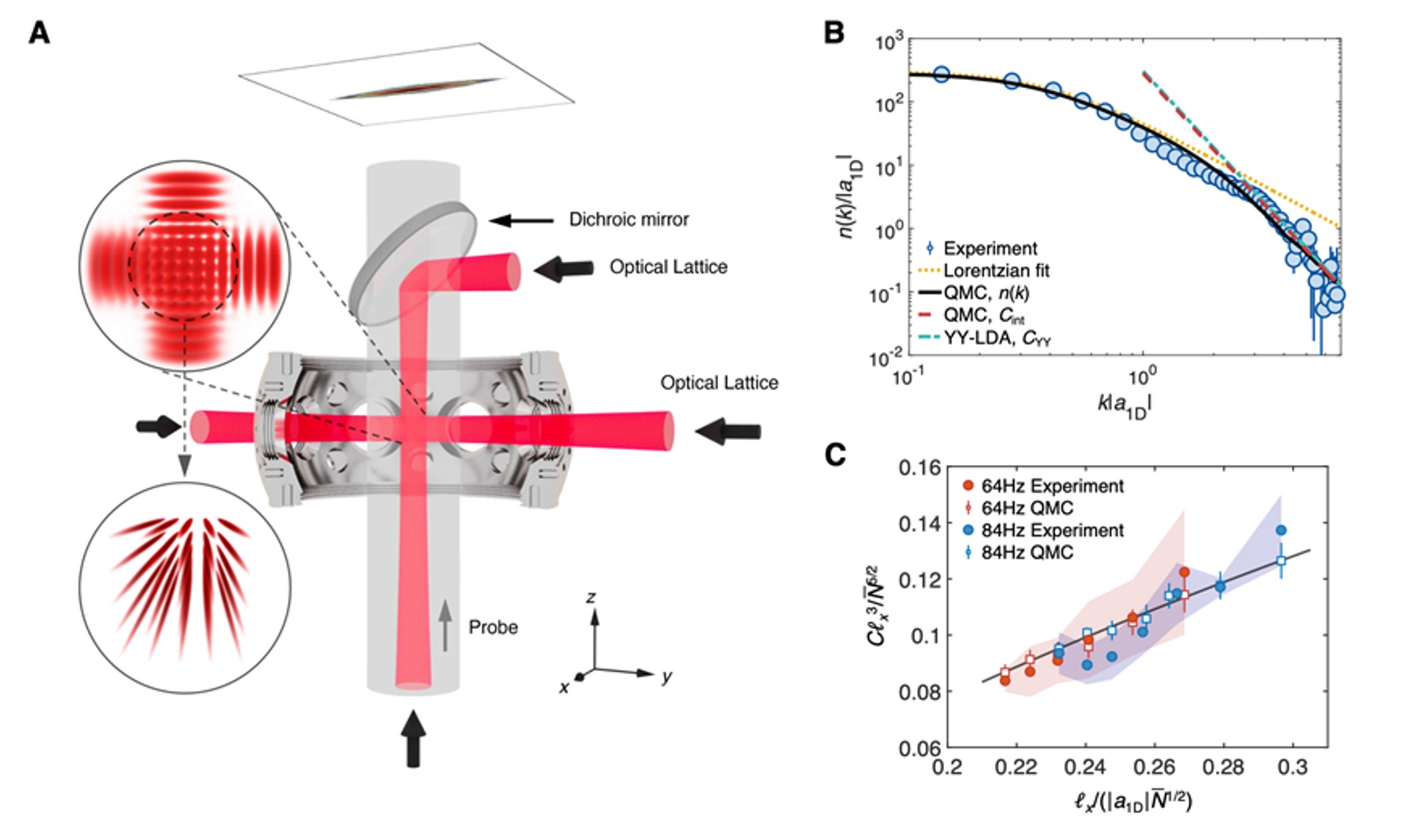
Figure 2. (A) A schematic of the quantum simulation platform used for measuring Tan's contact in a 1D strongly correlated Bose gas. (B) The momentum distribution obtained from both experimental measurements and Quantum Monte Carlo (QMC) simulations, where the weight of the 1/k⁴ tail yields Tan's contact. (C) The universal scaling law demonstrated by the excellent agreement between directly observed Tan's contact and QMC simulation results.
3. One-Dimensional Dissipative Dynamics in Collaboration with Prof. Wenlan Chen (Tsinghua University)
In collaboration with the group of Prof. Wenlan Chen at Tsinghua University, we reported the first experimental verification of the non-Hermitian linear response theory. This was achieved by observing universal anomalous dissipative dynamics in a one-dimensional (1D) strongly correlated quantum gas [Nature Physics 21, 530–535 (2025)].
In our experiment, we controllably introduced weak dissipation into a 1D quantum gas of ultracold Rubidium-87 atoms. By performing precision measurements of the system's dynamics at short timescales, we discovered that the atom number, N, decays sub-exponentially with the dissipation duration, t. The characteristic exponent of this decay was found to be dependent only on the system's interaction strength and, remarkably, independent of the dissipation strength. It also exhibited strong robustness against temperature variations. The measured value of this exponent is in excellent agreement with the theoretically predicted anomalous dimension of the 1D quantum gas. This work represents the first quantitative measurement of the anomalous dimension in a 1D system, thereby demonstrating the unique utility of the non-Hermitian linear response framework.
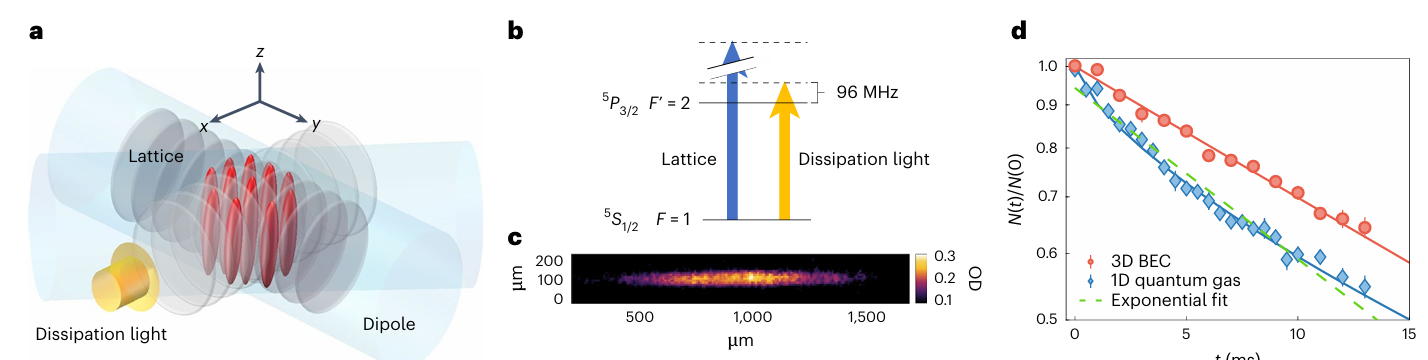
Figure 3. (a) Preparation of the 1D quantum gas. (b) Atomic energy levels and the choice of relevant dissipation light frequencies. (c) Absorption imaging of the 1D quantum gas after time-of-flight (TOF). (d) A comparison between exponential decay (BEC) and the observed sub-exponential decay (1D Bose gas).
Article Link: https://www.nature.com/articles/s41567-025-02800-4
News Link: https://quantum.phys.tsinghua.edu.cn/en/highlights/67b6e714a066ee470c34c5ce
4. Disorder-Induced Delocalization in Collaboration with Professor Giovanni Modugno at the Universities of Pisa and Florence (Featured in Physics)
In collaboration with Prof. Giovanni Modugno from the University of Pisa and the University of Florence, we investigated the Mott insulator transition in a shallow quasi-periodic lattice. We reported the first observation of an anomalous phenomenon: delocalization induced by disorder [Phys. Rev. Lett. 133(12), 123401 (2024)]. Under specific conditions, the quasi-periodic potential counteracts the formation of a Mott insulator, enabling a strongly interacting Bose gas to maintain its superfluid properties, thus demonstrating a delocalizing capability.
Through Quantum Monte Carlo simulations, we unveiled the underlying mechanism. When the filling factor (the ratio of the total number of particles to the number of lattice sites) is an integer, the quasi-periodic potential blurs the strict commensurability that would be present in a periodic lattice. This effect weakens the stability of the Mott insulating phase, thereby allowing the superfluid phase to persist. This research offers a new perspective on quantum phase transitions governed by the interplay of disorder and interactions.
Article Link: https://journals.aps.org/prl/abstract/10.1103/PhysRevLett.133.123401
Featured in Physics: https://physics.aps.org/articles/v17/s112

Figure 4. At a filling factor of one and constant lattice depth, transitioning from a periodic lattice (left) to a quasi-periodic lattice (right) drives the quantum state of the system from a Mott insulator to a superfluid.
Supervisor's Homepage: Yao, Hepeng-PKU ele