


Precision measurement includes atomic clocks, gravimeters, and gyroscopes.
Atomic Clocks
As one of the core carriers of the modern high-precision frequency standard, the research on time-keeping cesium clocks holds strategic significance for the construction of national time-frequency systems. It not only provides nanosecond-level synchronization capabilities for the frontier fields such as BeiDou navigation, high-speed communication and deep space exploration and but also serves as a critical cornerstone for safeguarding national information security and advancing the independent controlment of science and technology.

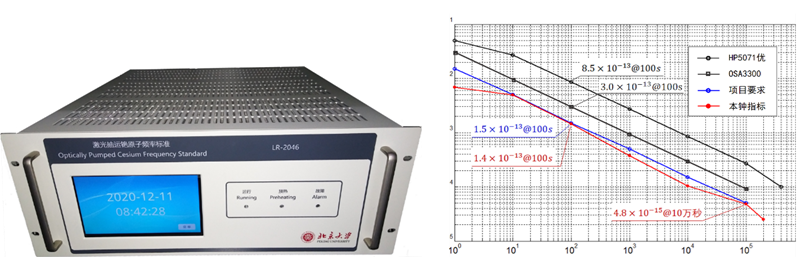
The CAP group of Peking University’s Institute of Quantum Electronics is one of the first groups to develop a time-keeping optically pumped cesium beam microwave clock in China. By leveraging interaction between microwave and Ramsey interference technology, the clock frequency is locked on the hyperfine energy level transition spectral line of the ground state of cesium atoms, which is also the foundation of the modern definition of the second. With the support of a number of major national projects and after nearly 20 years of intensive exploration, the frequency stability has been certified by the China Institute of metrology as short-term @1s, long-term @100,000s. It has achieved five times more than the cesium clock (5071A high-performance cesium tube) used in the U.S. GPS, which has reached the leading level in the field of international time-keeping cesium clock. The optically pumped microwave cesium clock developed by the group successfully breaks through the stranglehold technology of ultra-high-precision atomic clock. It establishes a time-frequency reference system with completely independent intellectual property rights for major projects such as the new generation of satellite navigation, deep space exploration and quantum sensing.
Recent works:
Two-laser optical pumping cesium clock for time-keeping
Recently, our group is making some research on using two lasers with different frequencies, that is, two-laser optical pumping, to significantly improve the atomic utilization efficiency and further explore the performance potential of optically pumped cesium clock.
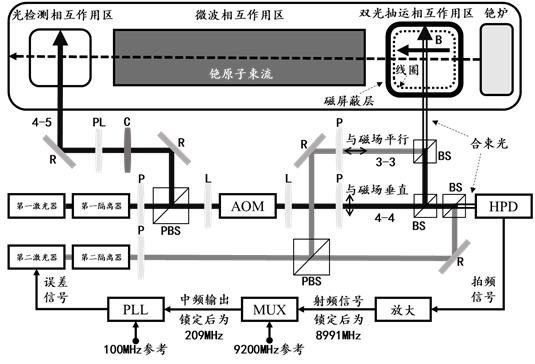
At present, the two-laser pumping mode adopted by our group is one laser of transition for pumping and the other laser of transition can exploit the forbidden transition between energy levels to drive the atoms to converge into the target Zeeman sublevel. By optimizing the frequency, polarization, light intensity and other parameters of the two lasers, the population of atoms in the clock transition state can reach 100% theoretically, which increases the maximum atomic utilization efficiency by 7 times. Consequently, the frequency stability limit of entire clock can be improved by 2-3 times. The breakthrough of this technology is expected to achieve a high-precision cesium clock with short-term stability comparable to hydrogen clock while maintaining superior long-term stability.
Optical lattice cold atom microwave clock
A novel optical lattice microwave clock scheme based on neutral cold atomic clusters combines optical lattice manipulation of atomic external momentum states with microwave Ramsey interference. This approach simultaneously achieves a high signal-to-noise ratio from a large population of atoms and ultra-narrow spectral linewidth from extended free evolution time.
In the ground environment, cold atomic clusters are rapidly prepared (10 milliseconds) via electromagnetically induced transparent cooling and loaded into an optical lattice. A Bloch laser transfers atomic momentum adiabatically and manipulates the external momentum state of cold atoms. This method can offset the free fall caused by gravity, which allows atoms to maintain a similar "suspension" effect for a long time within centimeter-scale in the center of the cavity. It can also maintain atomic coherence of atomic internal states for Ramsey interference, enabling an ultra-long free evolution time of the order of seconds. The linewidth of Ramsey fringes can be narrowed to the order of 0.1Hz. Combined with the high signal-to-noise ratio brought by a large number of atoms participating in the transition, it is projected to achieve a frequency stability of , and a long-term stability of the order of . This frequency stability index is equivalent to the current best large fountain clock (meter-scale height), while the system volume is reduced by an order of magnitude.
Gravimeters
Gravitational acceleration g is a crucial physical quantity in geophysical research, and its precise measurement is vital in fields such as gravitational wave detection, geological surveying, disaster prediction, and national security. The ultimate measurement precision of an atomic interferometric gravimeter is closely related to the free evolution time of atoms in the gravitational field, with longer free evolution times resulting in higher measurement precision. In traditional free-fall or fountain-type atomic interferometers, large physical system volumes are necessary to achieve high-precision measurements, often with interference regions extending over several meters, which limits the potential for miniaturization.
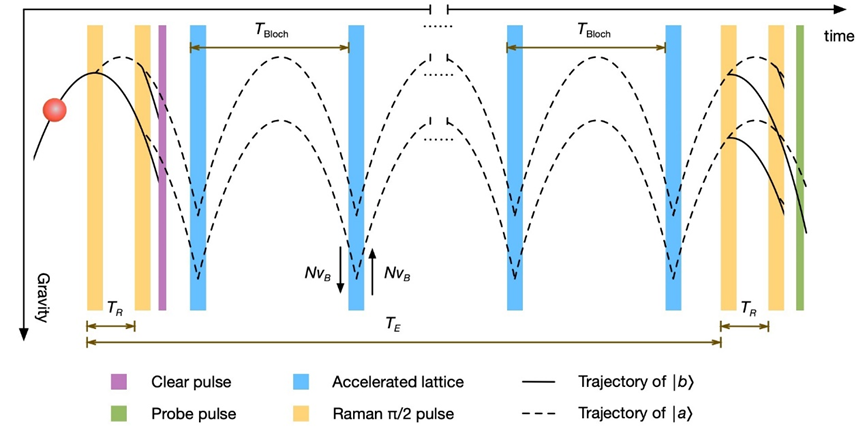
To achieve high-precision measurements while enabling miniaturization, we have combined traditional atomic interferometry with the manipulation of moving optical lattices. This approach has led to the development of a Ramsey-Bordé 87Rb atomic interferometric gravimeter. By utilizing the principle of Bloch oscillations in a moving optical lattice, we impart upward momentum to freely falling atoms, reversing their velocity. Multiple optical lattice pulses enable the atoms to undergo prolonged evolution within a smaller spatial region, thus achieving both high precision and compactness.
We were the first in China to achieve gravity measurement based on a moving optical lattice. The vertical displacement of the cold atoms is approximately 3 cm, which is two orders of magnitude smaller compared to the conventional Mach-Zehnder atomic gravimeters. The short-term sensitivity of the measurement can reach 4.52\times{10}^2\mu Gal/\sqrt{Hz},a level approximately twice that of similar international instruments. The system's ultimate resolution can reach,a level comparable to that of traditional free-fall gravimeters.
Building on the cold atom interferometer, we further achieved Bose-Einstein condensation (BEC) of 87Rb atoms in an all-optical trap. After evaporative cooling in a crossed optical dipole trap, we were able to prepare ultracold atoms with a temperature of approximately 52 nK and a particle number of around 1.6\times{10}^5. Based on the BEC system, we have conducted a series of scientific experiments.
Current Work:
Spatially Correlated Lattice Interferometer
Atomic interferometers, with their unprecedented precision, have become powerful tools for measuring fundamental physical constants and testing fundamental physical theories. Traditional atomic interferometry mainly focuses on the phase difference between two interference paths and relies on matter waves with well-defined coherence properties. In our recent work, we have implemented a Ramsey–Bordé interferometer of coherent matter waves loaded into a moving optical lattice along the direction of gravity. Furthermore, we have explored interference patterns arising from multi-path interference with tunable coherence. Through interferometric measurements, we have studied the spatial correlations of atoms within the optical lattice and between the two arms of the interferometer. Multiple interference peaks were observed, originating from the long-range coherence of the Bose–Einstein condensate. Interestingly, we observed that the positions of these interference peaks in both space and time deviate from conventional expectations. This led us to propose new insights into the question of when and where interference occurs in an atomic interferometer. Based on the dynamics of wavefunction expansion and collapse, we developed theoretical models that are in good agreement with experimental observations, providing a solid foundation for future high-precision measurements using ultracold atom interferometry. The details of this work can be found at https://doi.org/10.48550/arXiv.2406.16847
Investigation of Ramsey Fringes in a Microwave Atomic Clock Based on Optical Lattices
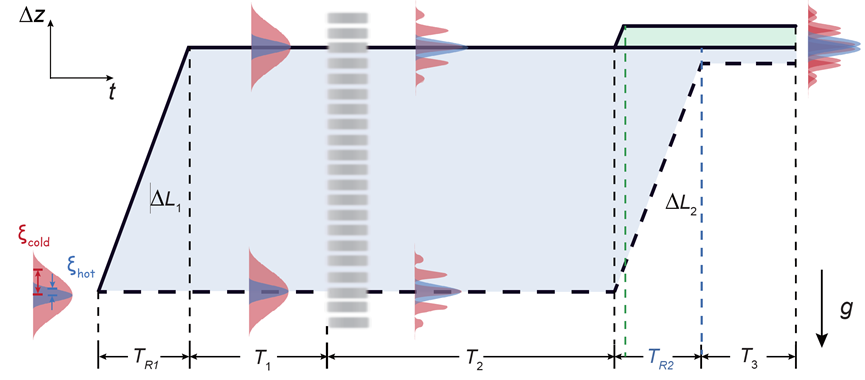
The Ramsey interference technique is the core technology of most microwave atomic clocks. To be specific, extending the free evolution time during the process is key to narrowing the fringe linewidth and enhancing the performance of atomic clocks. At present, the space-for-time scheme is generally adopted and the height of the fountain clock is increased to meter level. In our research, a new scheme to narrow the fringe linewidth is proposed by using the principle of Bloch oscillation of ultracold atoms in the moving optical lattice. During the free evolution time of the Ramsey interference process, a Bloch pulse applies recoil momentum in the opposite direction of gravity to the ultracold atoms, allowing the atoms to perform free-fall motion within a centimeter-scale cavity space. The main content of this research is to modify the experimental time sequence to increase the free evolution time, narrow the linewidth of Ramsey fringe of microwave clock transition, and research the decoherence problems caused by optical lattice, on the basis of the optical lattice gravimeter that has been realized. At present, we have achieved Ramsey fringes with a linewidth of approximately 3.3 Hz using this scheme. In the future, by increasing the number of moving optical lattice pulses and incorporating optical cavity technology, we expect to further extend the interference time, ultimately achieving Ramsey fringes with a linewidth comparable to that of fountain clocks. This advancement will lay a solid foundation for the development of compact, high-precision microwave atomic clocks.
Gyroscopes
The ultracold atomic interferometric gyroscope developed in this project is designed to meet the demands of fully autonomous navigation for modern strategic weapons, aiming to provide angular velocity measurement equipment with higher sensitivity and improved stability. Compared to optical gyroscopes, atomic gyroscopes exhibit superior theoretical angular velocity resolution due to their matter-wave properties. To fully leverage these theoretical advantages, it is essential to maximize the utilization of atomic matter-wave characteristics. Ultracold atoms, with their extremely low kinetic energy distribution and high coherence, are ideal for high-precision measurements and are regarded as the most promising medium for unlocking the potential of atomic interferometers. However, due to technical challenges in preparing and manipulating ultracold atoms, gyroscopes in this field are still in their infancy. Although existing ultracold atomic gyroscopes generally lack high angular velocity resolution, they hold significant future potential.
This system combines atomic Sagnac interferometry with magnetic levitation technology based on a quadrupole magnetic trap, achieving a gyroscope sensitivity surpassing 3×10⁻⁵ rad/s. Innovatively integrating ultracold atoms, Bragg lattice pulses, and quadrupole magnetic trap orbital guidance, this project has developed a compact, high-precision gyroscope with breakthroughs in angular velocity accuracy, system mobility, and matter-wave interference mechanisms. Additionally, benefiting from the low noise of the static magnetic trap, this instrument achieves internationally leading angular velocity sensitivity per unit area.
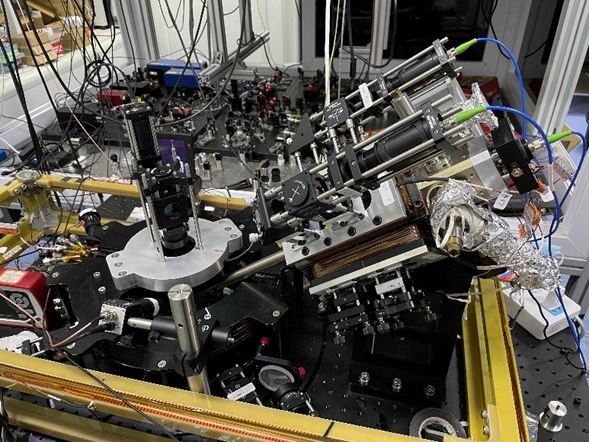
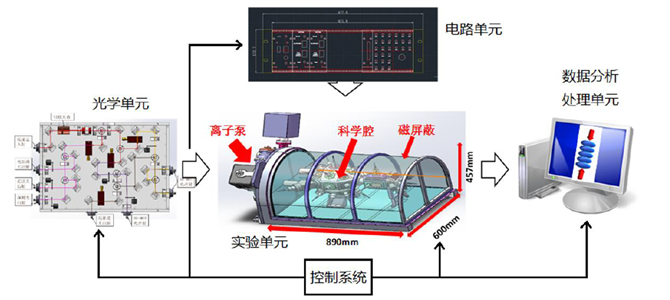
Figure 1. Ultracold Atomic Interferometric Gyroscope System
Measurement of Atomic Interference Signals
Based on the Bose-Einstein condensate (BEC) prepared and loaded into the magnetic trap in prior steps, we first apply a Bragg pulse to split the atomic cloud and propel it into the orbit. When the atoms reach the farthest point from the trap center, a second Bragg pulse—orthogonal to the first—is applied, imparting momentum to the atoms for circular motion around the center of the quadrupole magnetic trap. After completing an integer number of orbits, the atomic cloud returns to its pre-split position, where a third Bragg pulse is applied to partially restore the atoms to the zero-momentum state. The proportion of atoms in this state contains the phase information required for measurement. During the experiment, both upper and lower atomic clouds undergo interference measurements, and differential processing eliminates common-mode noise. Leveraging the Sagnac effect, the phase difference is extracted from the results to calculate the angular velocity. After several hours of measurement, the system achieves an angular velocity resolution exceeding 3×10⁻⁵ rad/s.
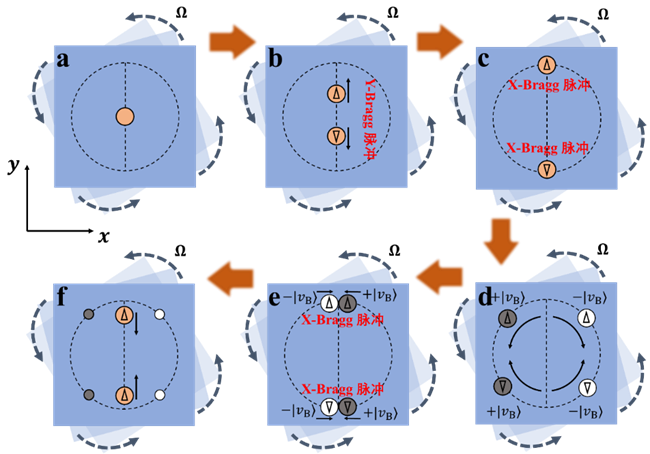
Figure 2. Schematic Diagram of Atomic Interference
Magnetic State Selection During Evaporation
Since the system employs a quadrupole magnetic trap to confine atoms for interferometric measurements, only Rb⁸⁷ atoms in the specific magnetic sublevel (mF = -1) can be trapped. Thus, maximizing the preparation of Rb⁸⁷ atoms in the -1 state is critical. To achieve this, a quadrupole magnetic field and a bias magnetic field are activated during optical trap evaporation cooling. By adjusting parameters such as magnetic field duration, gradient strength, and central position, the distribution of atoms across magnetic sublevels in the resulting BEC can be controlled. Experimentally, the proportion of -1 state atoms was increased from 1/3 to over 97%, with theoretical analysis and modeling conducted to support the process. The figure below shows the distribution of atoms across magnetic sublevels in the BEC under three different parameter sets during magnetic state selection. As illustrated in Figure 3c, the optimized process successfully concentrates most atoms in the -1 state.
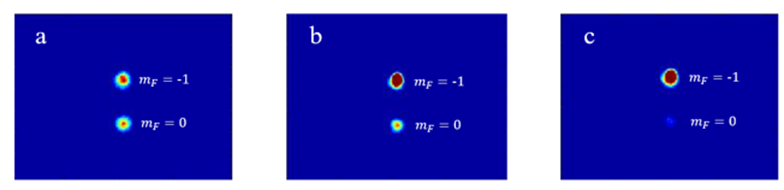
Figure 3. Alteration of Atomic Magnetic Moments via Magnetic State Selection