


Founded in 2016, the Space Rubidium-Potassium (Rb-K) Group aims to achieve a ultracold degenerate quantum gas mixture of 87Rb and 40K, and to build a ground prototype for the Ultracold Atomic Cabinet aboard the China Space Station. The group is supervised by Professor Wei Xiong. Research directions include: realizing a Rb-K ultracold degenerate mixture, ground-based validation of the space station’s ultracold atomic system, ground-to-space experiment correlation, and exploring novel quantum phenomena in ultracold Fermi systems.
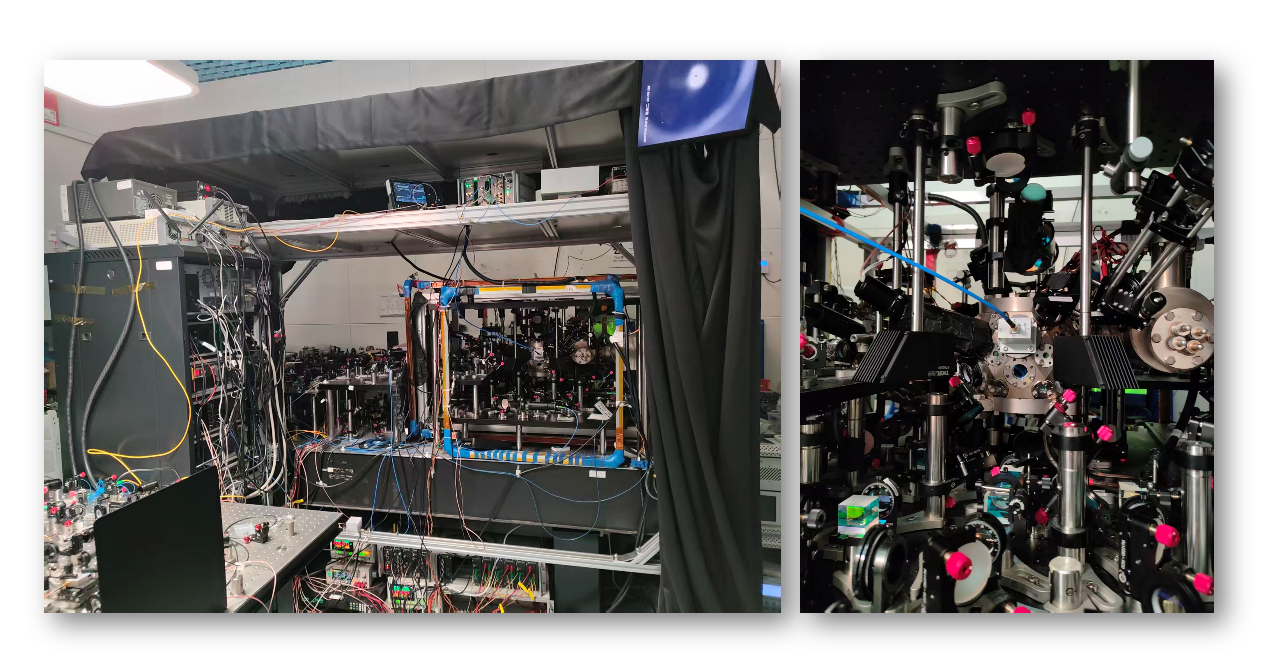
Rb-K Ultracold Atomic System Setup
Our group is actively developing a ground-based ultracold atomic experimental system for Rb-K mixtures. This system serves as a key ground validation platform for the Ultracold Atomic Cabinet on the China Space Station, providing a reference for technical parameters for in-orbit experiments while exploring quantum gas co-manipulation techniques. It lays the foundation for future multi-component quantum degenerate gas experiments aboard the space station.
We have successfully prepared a Rb-K degenerate mixture, achieving a 87Rb Bose–Einstein condensate below 50 nK and a 40K Fermi degenerate gas at 100 nK. The system is designed to incorporate optical lattices and Feshbach resonance techniques, enabling future studies of novel phenomena in strongly correlated systems in optical lattices and boson–fermion mixtures. In the longer term, it will provide a ground-based simulation platform for frontier research such as quantum phase transitions and ultracold molecule synthesis for the space station.
Space Station Ultracold Atomic System

Our group serves as the scientific responsible entity for the development and in-orbit experimental work of the Cold Atom Physics Rack (CAPR) aboard the Mengtian laboratory module of China's Space Station. This experimental system is China's first and one of the world's leading in-orbit ultra-cold atomic physics platforms, marking a major breakthrough in the field of space quantum technology. To address the unique constraints of the space microgravity environment, the team has overcome multiple key technical challenges: we innovatively designed a microgravity optical trap evaporative cooling scheme as well as a two-stage cooling scheme. During the in-orbit experimental phase, we successfully prepared and observed Bose-Einstein condensates (BECs). We also equipped CAPR with a three-dimensional optical lattice system and have successfully achieved loading of the optical lattice in space. These achievements provide a unique experimental platform for cutting-edge explorations such as topological quantum simulation and novel quantum states of matter, and also lay key technical foundations for future applications in space-based quantum precision measurement and quantum sensing. The project team is continuously conducting in-depth mining of in-orbit data and has begun planning the development of the next-generation space ultra-cold atomic experimental system.
Publications:
[1] Hui Li, Biao Wu, Jiachen Yu, Xiaolong Yuan, Xiaoji Zhou, Bin Wang, Weibiao Chen, Wei Xiong, and Xuzong Chen. Momentum filtering scheme of cooling atomic clouds for the Chinese Space Station. Chinese Optics Letters 21, 080201 (2023).
[2] Xiao-long Yuan, Jiachen Yu, Hui Li, Biao Wu, Wei Xiong, Xiaoji Zhou, and Xuzong Chen, “Dynamic equation for evaporative cooling of trapped atoms in microgravity,” Physical Review A 109, 043315 (2024).