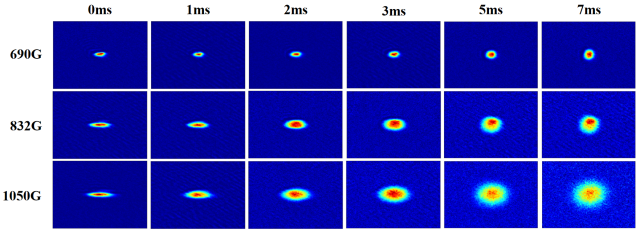
Welcome to the DFG-Li6 Lab! Established in August 2022, our lab achieved Fermi degeneracy in mid-2023. We can access strongly interacting molecular Bose-Einstein condensates (mBECs) and fermionic atomic gases across the entire BEC-BCS crossover using a Feshbach resonance. Our experimental setup comprises a Zeeman slower and an all-titanium science chamber, housing a triangular lattice in the horizontal plane and a 1D confining lattice in the vertical direction. A well-designed quantum gas microscope, currently planned for future integration, will enable single-site resolved imaging and single-atom manipulation within the lattice.
The robust lattice architecture, sophisticated control techniques, and tunable interactions allow us to explore a rich variety of quantum phases in higher lattice bands/orbitals, as well as complex phase diagrams associated with dimensional crossovers, delving into the intricacies of quantum many-body systems. Furthermore, we are actively investigating the potential applications of fermionic atoms in optical lattices for quantum computation.

Recent Main Work:
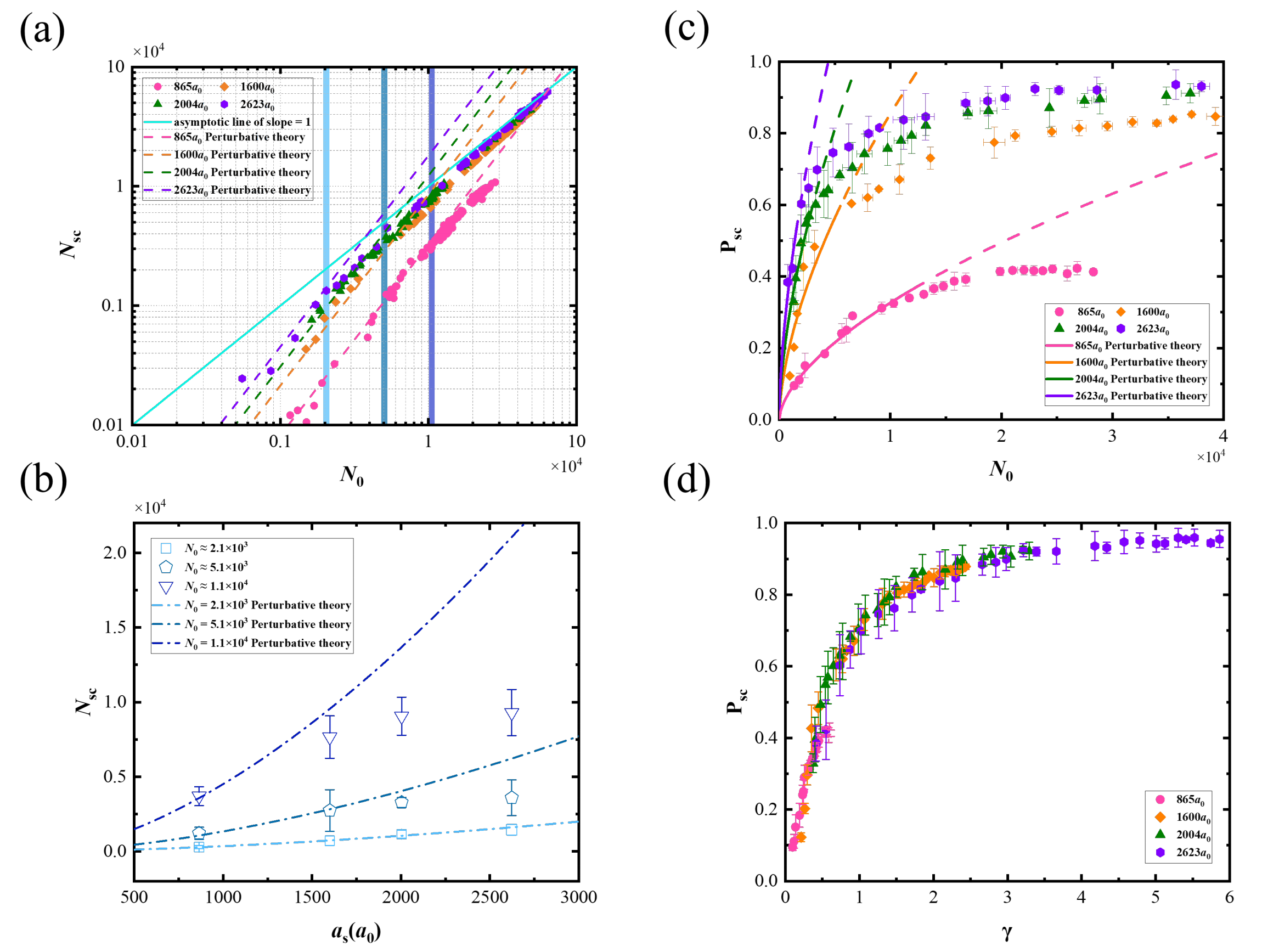
Scattering halos in strongly interacting Feshbach molecular Bose-Einstein condensates
Abstract: We investigate the scattering halos resulting from collisions between discrete momentum components in the time-of-flight expansion of interaction-tunable 6Li2 molecular Bose-Einstein condensates. A key highlight of this study is the observation of the influence of interactions on the collisional scattering process. We measure the production of scattering halos at different interaction levels by varying the number of particles and the scattering length, and quantitatively assess the applicability of perturbation theory. To delve into a general theory of scattering halos, we introduce a scattering factor and obtain a universal relation between it and the halo ratio. Furthermore, we simulate the formation of scattering halos under non-perturbative conditions and discuss the contribution of in trap dynamics to the scattering halos through a return pulse experiment. This study enhances our understanding of the physical mechanisms underlying scattering processes in many-body systems and provides new perspectives for further theoretical research.
àRelated publication: Physical Review A 111, 043303 (2025)
https://doi.org/10.1103/PhysRevA.111.043303
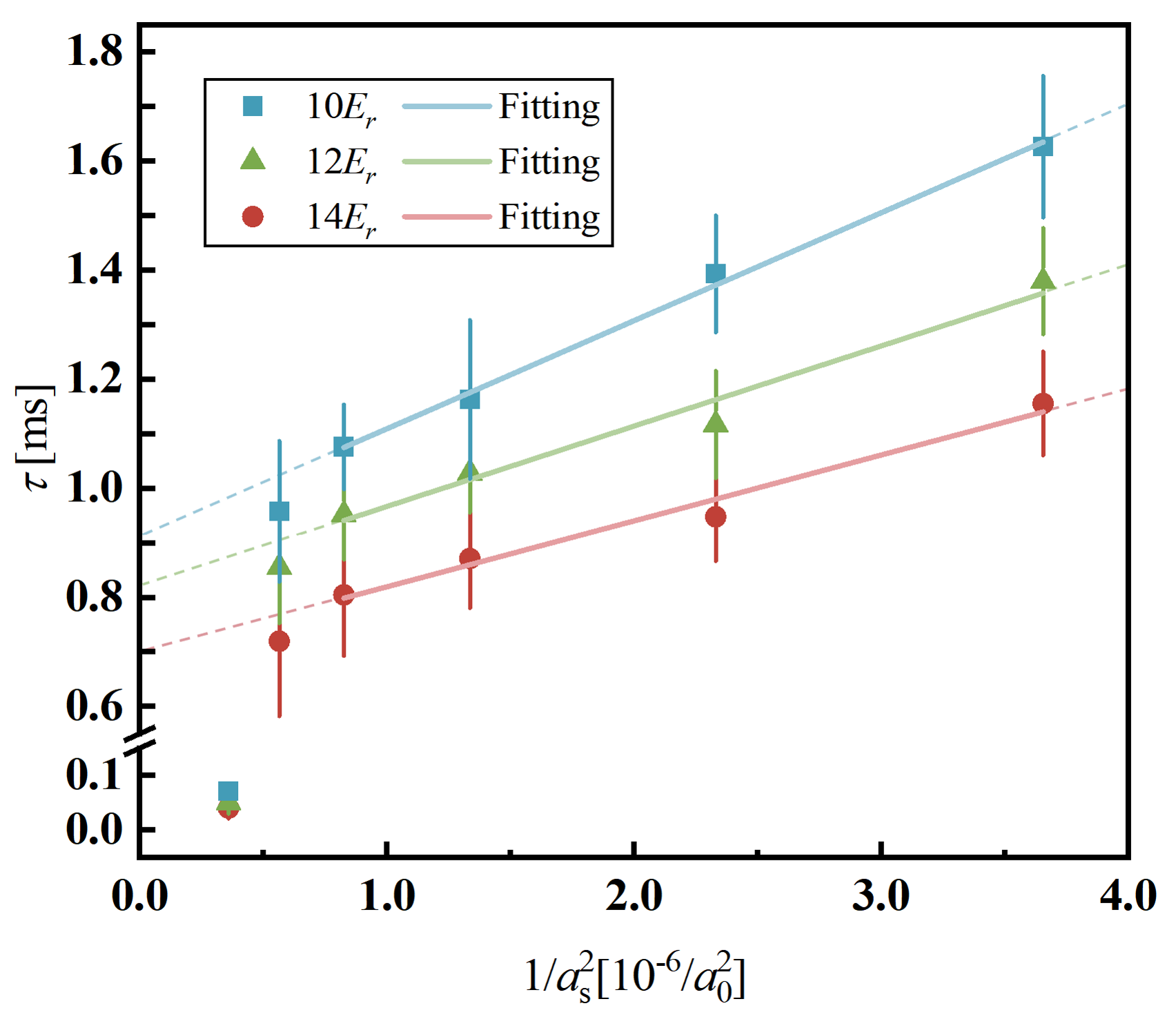
Collisional scattering of strongly interacting D-band Feshbach molecules in optical lattices
Abstract: The excited bands in optical lattices manifest an important tool for studying quantum simulation and many-body physics, making it crucial to measure high-band scattering dynamics under strong interactions. This work investigates both experimentally and theoretically the collisional scattering of 6Li2 molecular Bose-Einstein condensate in the D band of a one-dimensional optical lattice, with interaction strength directly tunable via magnetic Feshbach resonance. We find a clear dependence of the D-band lifetimes on the interaction strength within the strongly interacting regime, which arises from the fact that the scattering cross-section is proportional to the square of the scattering length. The maximum lifetime versus lattice depth is measured to reveal the effects of interactions. We also investigate the scattering channels of D-band molecules under different interaction levels and develop a reliable two-body scattering rate equation. This work provides insight into the interplay between interaction and the collisional scattering of high-band bosons in optical lattices, paving the way for research into strong correlation effects in high-band lattice systems.
àRelated publication: Physical Review Research 7,023030 (2025)
https://doi.org/10.1103/PhysRevResearch.7.023030
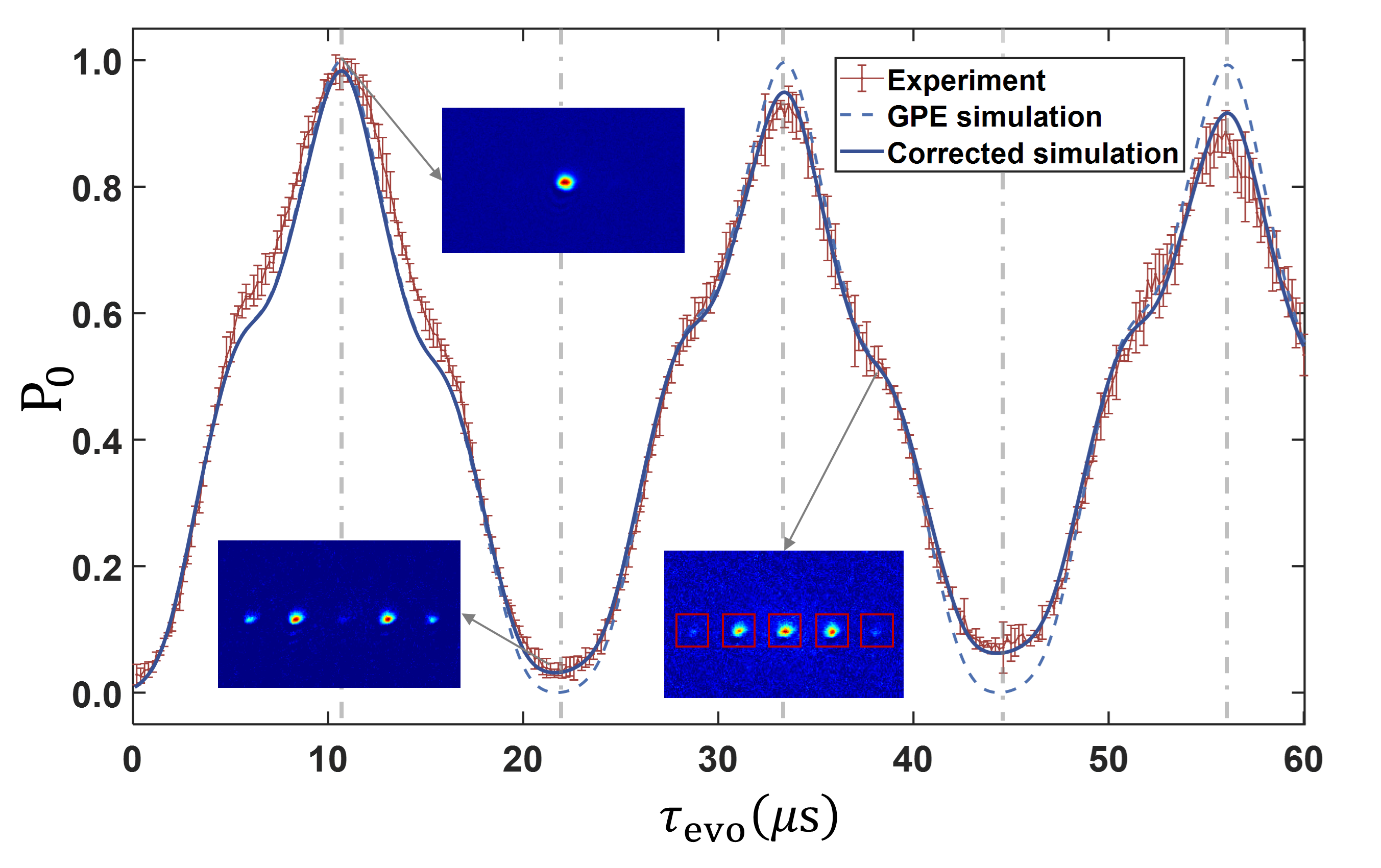
Temporal Talbot interferometer of strongly interacting molecular Bose-Einstein condensate
Abstract: Talbot interferometer, as a periodic reproduction of momentum distribution in the time domain, finds significant applications in multiple research. The inter-particle interactions during the diffraction and interference process introduce numerous many-body physics problems, leading to unconventional interference characteristics. This work investigates both experimentally and theoretically the influence of interaction in a Talbot interferometer with a 6Li2 molecular Bose-Einstein condensate in a one-dimensional optical lattice, with interaction strength directly tunable via magnetic Feshbach resonance. A clear dependence of the period and amplitude of signal revivals on the interaction strength can be observed. While interactions increase the decay rate of the signal and advance the revivals, we find that over a wide range of interactions, the Talbot interferometer remains highly effective over a certain evolutionary timescale, including the case of fractional Talbot interference. This work provides insight into the interplay between interaction and the coherence properties of a temporal Talbot interference in optical lattices, paving the way for research into quantum interference in strongly interacting systems.
àRelated publication: Physical Review A109,043313(2024)
https://doi.org/10.1103/PhysRevA.109.043313